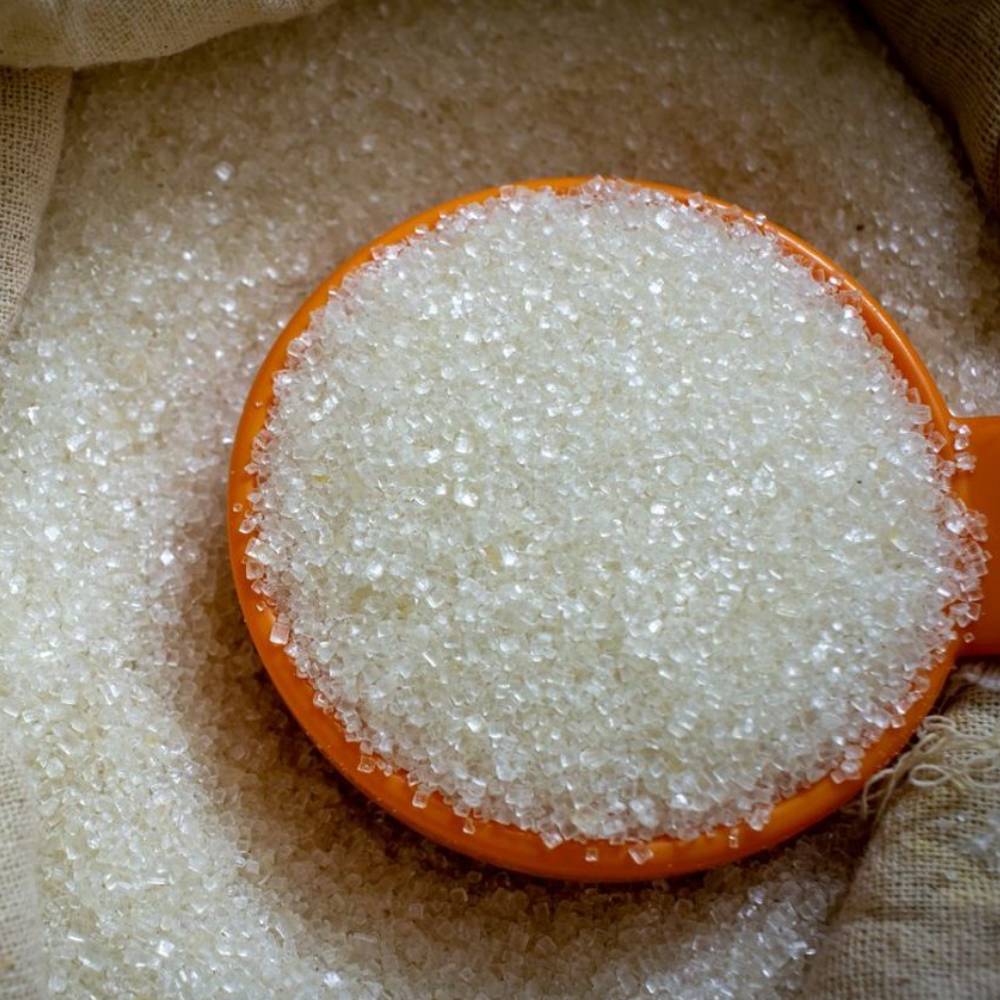
We offer our customers Indian Origin and Brazil Origin Sugar.
RAW SUGAR is manufactured from the natural juice extracted by crushing the sugarcane. The juice is then mixed with lime to achieve the desired ph balance and to help settle out impurities. Reduction of this solution through evaporation produces a solid mass that is passed through centrifuge to get sugar crystals. It is then dried further to produce granules. This Sugar is Light Brown in colour and is called RAW SUGAR. The brown colour of Raw Sugar is due to presence of Molasses. Raw Sugar is the most natural sugar. Raw Sugar is in light, golden brown crystals that has a mild caramel taste. Crystals that form in the liquid are granules called Raw Sugar. After going through filtration and hot water washes, the sugar contains 96% sucrose and 4% plant materials contained in the mother liquid. Vacuum drying this product leaves a golden brown colour and sweet taste but little nutritional value, except for calories from the carbohydrate content. The Raw Sugar can either go to consumer or to the refinery for further processing.
After filtering out plant trash and raw sugar crystals, the millers slowly evaporate the liquid, resulting in a rich brown mixture called molasses. Molasses contains 46% dissolved sucrose and other sugars, 3% protein, small amount of minerals like calcium, phosphorous, magnesium and sulphur; trace
elements such as copper, iron, manganese, zinc and B- Vitamins. Molasses is used for both human and animal consumption. Producers may mix it with Raw Sugar to facilitate transport to refinery or with White Sugar to yield Brown Sugar.
BROWN SUGAR is simply refined White Sugar with molasses syrup mixed in, and then dried again. It is dark in colour and stickier in texture and has a definite caramel taste. The amount of molasses added depends on the producers, but you could expect light brown sugar to contain 3.5 % molasses, while dark brown sugar might contain 6.5 % molasses. Brown sugar imparts the taste of molasses to recipes and adds moisture to make a softer texture.
WHITE SUGAR is produced by adding sulphur dioxide to sugarcane juice before it gets evaporated. This gas does the bleaching of the juice so that it does not turn brown and produces White Sugar. At later stages phosphoric acid, calcium hydroxide or carbon dioxide is added to absorb impurities. This juice is then filtered through a bed of carbon and then crystallized in a vacuum many times. Finally, the crystals are left to dry on their own to get White Crystals of sugar. This goes to grinding machine that produces different sizes of granules for use in household and commercial cooking and flavouring.
INDIAN SUGAR SPECIFICATIONS:
| 1] Product |
Indian Sugar S- 30 |
Indian Sugar M- 30 |
| 2] Origin |
India |
India |
| 3] ICUMSA |
100 RBU to 150 RBU |
100 RBU to 150 RBU |
| 4] ICUMSA Colour S- 30 |
80 to 100 |
ICUMSA Colour M- 30, 95 to 105 |
| 5] Crystal Size S- 30 |
0.80 mm to 1.20 mm |
Size M- 30, 1.40 to 1.70 mm |
| 6] Ash Content |
0.50 % Max |
0.40 % Max |
| 7] Moisture |
0.50 % to 0.70 % Max |
0.40 % to 0.60 % Max |
| 8] Solubility |
100 % Dry and Free Flowing |
100 % Dry and Free Flowing |
| 9] Granulation |
Fine Free Flowing |
Fine Free Flowing |
| 10] Polarization |
99.50 % Min |
99.50 % Min |
| 11] Colour |
Sparkling White |
Sparkling White |
| 12] Substance |
Solid Crystal |
Solid Crystal |
| 13] Smell |
Free of any smell |
Free of any mell |
| 14] LOAD ABILITY |
25 MT in a 20 Feet Container |
25 MT in a 20 Feet Container |
BRAZIL SUGAR ICUMSA- 45
| 1] Product |
ICUMSA- 45 RBU White Refined Sugar |
| 2] Origin |
Brazil |
| 3] Ash Content |
0.04 % Max by weight |
| 4] Moisture |
0.04 % Max by weight |
| 5] Magnetic Particles |
4 mg / Kg |
| 6] Solubility |
100 % Dry and Free Flowing |
| 7] Granulation |
Fine Standard |
| 8] Polarization at 20 Degree C |
99.80 % Min |
| 9] Max AS |
1 ppm |
| 10] Max OS |
2 ppm |
| 11] Max CU |
3 ppm |
| 12] Colour |
Sparkling White |
| 13] SO |
20 mg/kg |
| 14] Reducing Sugar |
0.010 % Min in dry mass |
| 15] Radiation |
Normal w/o Presence of caesium or iodine SO 2 Certified |
| 16] Substance |
Solid Crystal |
| 17] Smell |
Free of any Smell |
| 18] HPN Staph Aureus per 1 gm |
Nil |
| 19] Microbiological Limits:
A] Pathogenic Bacteria Including Salmonella Per 1 gm
B] Bacillus per 1 gm |
Nil
Nil |
| 20] Pesticides Traces Max Mg/kg |
DDT 0.005, Phototoxin 0.01, Hexachloran – Gamma isomer 0.005 |
| 21] ICUMSA |
Colour 45 ICUMSA attenuation index limits max [Method No. 10-1978] |
| 22] Product suitable for Human Consumption |
Phytosanitary Certificate of No Radiation, No virus, No Insect Parts, No Rodent
Excrement, No Husk and No Poisonous Matter |
PACKING: in 50 kg bags
LOAD ABILITY: 25 MT IN A 20 FEET CONTAINER
MINIMUM ORDER QUANTITY: For Indian Sugar 250 MT
For BRAZILIAN SUGAR 12500 MT in Bulk Vessel
ICUMSA:
ICUMSA is an international organization [International Commission for Uniform Methods of Sugar Analysis] helps develop analytical methods for sugar industry. ICUMSA publishes a Method Book that contains detailed instructions for analysing all types of sugar. An ICUMSA rating is an international unit that expresses the purity of sugar in solution and directly related to the sugar colour.
Sugar manufacturers determine the ICUMSA rating with an instrument called TRISTIMULUS COLORIMETER that measures the exact colour of the sugar and gives it a numerical reading. Sugar colour is directly related to how much refining it has been through. The colour of raw sugar is very dark while highly refined sugar is the sparkling white colour. The Colorimeter directs wavelengths of light at the sugar sample and detects which sugar absorbs the light and which sugar reflects back. Dark colours absorb much more lights than light colours, which mean that the Colorimeter indicates a low rating for highly refined sugar and higher ratings for raw sugar.




 WhatsApp